
Can the spiritual paths of the world be placed on a single map? Ken Wilber thinks they can, at least in part. In The Religion of Tomorrow (2017), he gathers stages of meditative development from several traditions and arranges them side by side. The effort is ambitious and useful, and it also raises a fair question: what is gained, and what is lost, when very different traditions are made to share one ladder?
The Mystic’s Journey
In his discussion of meditative states (Wilber, 2017, p. 92), Wilber draws on Evelyn Underhill’s classic study of Western mysticism (1911). Underhill traced the Christian mystic’s path through a sequence of stages, commonly summarized as awakening, purification, illumination, the dark night of the soul, and union.
What makes this map valuable is that it normalizes the difficult middle of the journey. An initial awakening is often intense, and it is typically followed by a long period of purification, a gradual deepening of insight, and sometimes a stretch of profound darkness or loss of meaning. Without a map, these phases can be mistaken for failure or regression. With one, they can be recognized as recurring features of contemplative development that mystics described across centuries.
Enter the Chakras
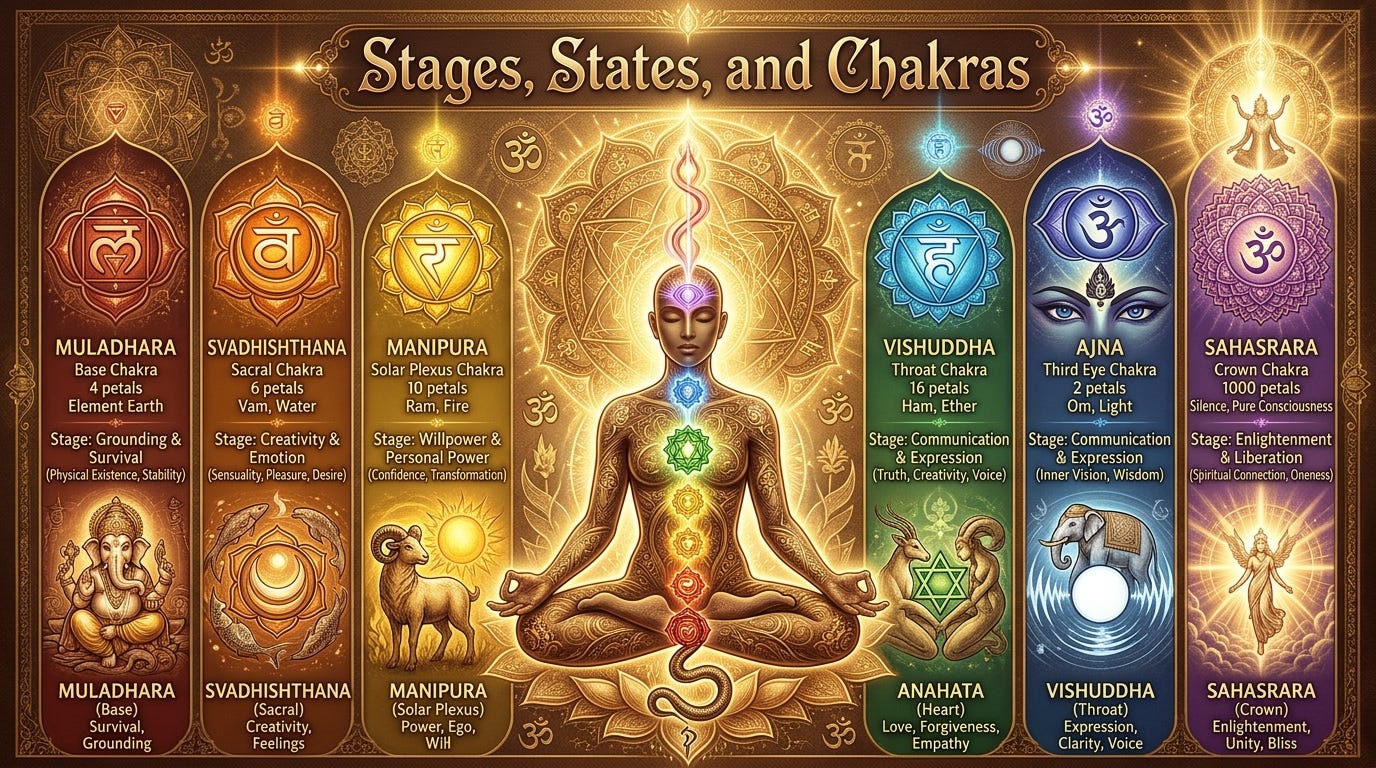
Immediately after this material, Wilber turns to the seven chakras of yogic theory and links each one to a stage of development. For example, he associates the heart chakra with the mythic-membership stage.
In doing so, he attempts to build a universal spiritual map. Modern Western models of development are superimposed onto Eastern frameworks, including the yogic chakra system and Buddhist meditative stages. There is real value in this. Placing traditions side by side helps practitioners and researchers notice patterns that might otherwise stay hidden within the boundaries of a single lineage.
Where the Traditions Disagree
The difficulty is that the traditions themselves do not speak with one voice.
Within the yogic and tantric traditions of Hinduism, there is no single agreed account of how the chakras relate to spiritual development. Even the number of chakras varies across texts, although the most widely known system presents six chakras plus the crown (Avalon, 1919/1974).
Kundalini yoga, for instance, teaches that enlightenment occurs when kundalini energy rises from the mūlādhāra (root chakra) to the sahasrāra (crown chakra) (Avalon, 1919/1974). The path is imagined as an ascent, and the crown is its summit.
Ramana Maharshi taught something different. For him, final realization abides not in the crown but in the spiritual Heart (hṛdaya), even if kundalini has already risen to the sahasrāra (Ramana Maharshi, 2006). In this view, the heart is not a midway station on the way up. It is the destination, and in some sense the origin.
This difference matters for anyone interested in heart-centered practice. A ladder with the heart in the middle and a ladder with the heart at the center of everything describe two very different relationships to the same organ of awareness.
The Risk of One Ladder
These disagreements suggest that a single universal map may simplify traditions that were never in full agreement among themselves. Underhill’s stages emerged from the lives of Christian mystics, shaped by their theology, their language, and their communities. The chakra system arose within the tantric traditions of India, with its own cosmology and its own internal debates.
Placing them on one developmental ladder may reveal real similarities. It may also flatten what makes each path distinctive. This is a familiar tension in comparative spirituality, and it echoes the long-standing debate over the perennial philosophy: how much of the unity between traditions is discovered, and how much is imposed by the person drawing the map?
A Balanced Way to Use the Map
Wilber’s framework is most useful when it is treated as a tool for recognizing similarities across traditions, while still honoring the unique wisdom of each path. A map is meant to orient, not to replace the territory. Used this way, it invites comparison without demanding that every tradition agree to be translated into the same terms.
Reflect on This
If one tradition places the heart midway along the path and another places it at the very center of realization, what changes in how you would practice?
References
Avalon, A. (1974). The serpent power: The secrets of tantric and shaktic yoga. Dover Publications. (Original work published 1919)
Ramana Maharshi. (2006). Talks with Sri Ramana Maharshi. Sri Ramanasramam.
Underhill, E. (1911). Mysticism: A study in the nature and development of man’s spiritual consciousness. Methuen.
Wilber, K. (2017). The religion of tomorrow: A vision for the future of the great traditions. Shambhala.