
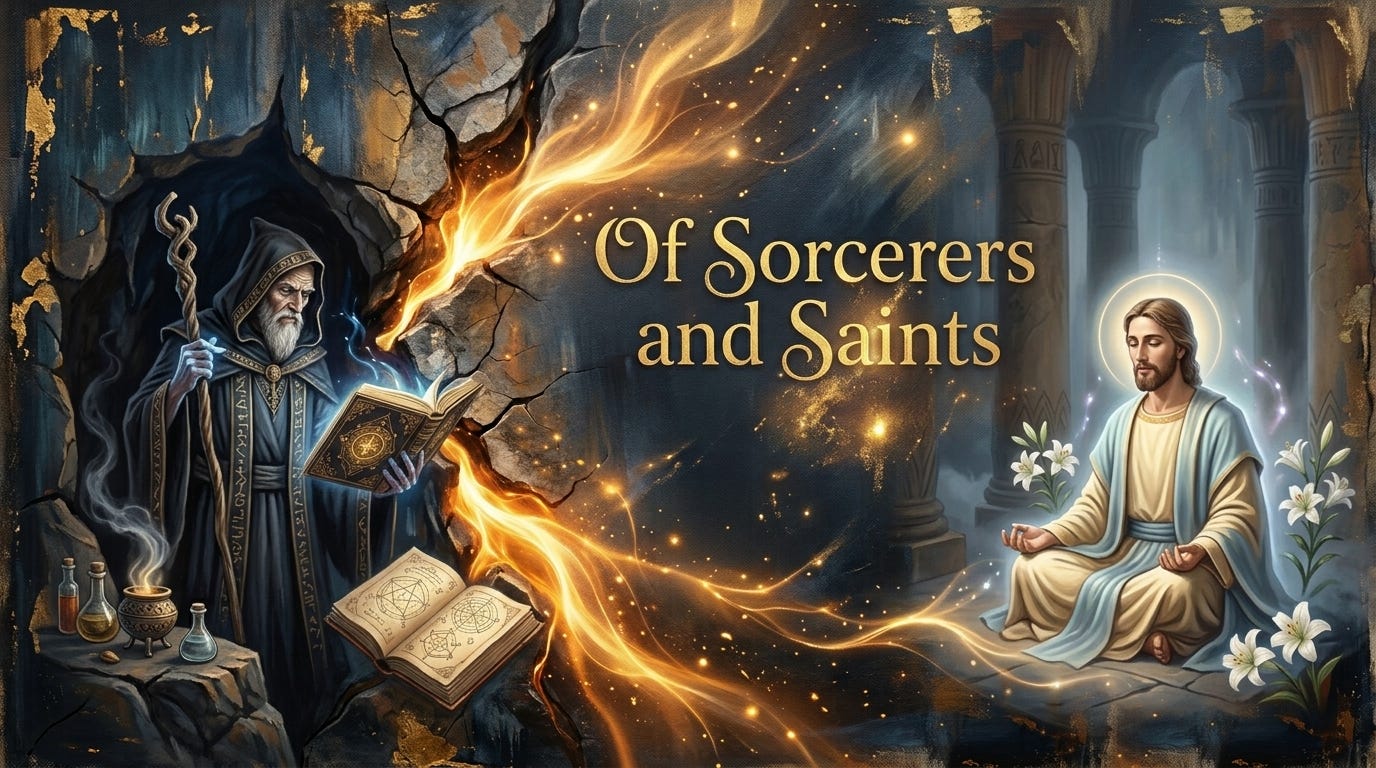
Where does religion end and magic begin? The question is old, and it has never been fully settled. It sits at the center of a debate between two Neoplatonist philosophers, Porphyry and Iamblichus, and it still has something to say about how we understand ritual, intention, and the pursuit of desire.
Tokens Placed by the Gods
Iamblichus describes sunthēmata (sounds, animals, plants, and stones) as “passwords and tokens placed by the gods” to enable us to reach them (Shaw, 2014, p. 183). A modern comparison might be a video game in which tokens, cheat codes, and walkthroughs unlock “extra power.” The comparison is imperfect, but it captures the basic idea: the natural world is seeded with keys, and the right use of them opens a door.
The idea is fascinating because it treats the material world as a vehicle for reaching the divine rather than an obstacle to it. It also raises an uncomfortable question about who gets to turn the key, and for what purpose.
Where Is the Boundary?
If sounds, plants, animals, and stones can be used to reach the gods, where does the boundary between religion and magic lie?
Porphyry raised exactly this objection, accusing the theurgists of sorcery (Shaw, 2014, p. 178). Iamblichus responds that “the sacrifice of a material object released the will of the Demiurge” (as cited in Shaw, 2014, p. 178). But does that really answer the question? E. R. Dodds observed that the rituals of sorcery and theurgy would have been “indistinguishable to the uninitiated” (as cited in Shaw, 2014, p. 209). From the outside, the two can look identical.
Iamblichus draws the line elsewhere. According to him, sorcery adds to the perversion of the universe, while theurgy drives the universe towards perfection (Shaw, 2014, p. 191). That leaves a pointed question: what, precisely, is the crucial difference between perverting and perfecting the eternal balance of the cosmos in the ritual use of sunthēmata?
Intention as the Dividing Line
Elsewhere, Iamblichus says that if someone takes things and “diverts them to another purpose and illegitimately achieves something, the damage from what he has evilly used will fall on him personally” (as cited in Shaw, 2014, p. 191).
This suggests that using the natural powers of the universe through the sunthēmata for personal desire would “pervert” the universe, whereas using them for communion with the divine would perfect it. It is a profound distinction, because it relocates responsibility. It is not the sunthēmata that bear it, but the one who uses them. It is also not the ritual that is right or wrong, but the intention with which it is performed.
The same outward act, such as the offering of a sacrifice, can be an act of devotion in one setting and an act of malice in another. A worshipper may offer a sacrifice to honor the divine, while a sorcerer may perform an identical act for a harmful end. The act is the same. The orientation is not.
This leads to a further question: is religion, understood as reaching for the Divine through ritual, itself a form of magic? If intention is the only real difference, the answer may depend less on what is done than on why.
Light and Darkness
Symbolically and culturally, saints are regarded as bearers of light and sorcerers as carriers of darkness. It seems fair to say that invoking and connecting to the divine increases light, whereas following base, material, and personal desires increases darkness.
Seen this way, a modern capitalist world that runs largely on the fuel of personal desire can be read as steeped in darkness. This is a sharp claim, and a debatable one, but it follows naturally from the Iamblichean premise: if the use of the world’s powers for personal gain perverts the order of things, then an entire economy organized around personal gain deserves scrutiny.
An Unfinished Question
These questions do not resolve neatly, and there is value in leaving them open. What the discussion does clarify is a single principle. If intention is truly the only difference between the saint and the sorcerer, then Iamblichus may be right that the Creator placed the sunthēmata on earth so that humans could use them to reach the divine. The tokens are neutral. The path depends on the one who holds them.
Reflect on This
If the same act can lead toward light or toward darkness depending on its intention, how would you recognize the difference in your own actions?
Reference
Shaw, G. (2014). Theurgy and the soul: The Neoplatonism of Iamblichus (2nd ed.). Angelico Press.