
There’s a particular kind of intellectual vertigo that comes from encountering an idea that reorganizes everything you thought you understood about a subject. That happened to me recently, reading Zak Stein’s argument that education itself might be the metacrisis: the single, underlying condition generating the tangle of ecological, political, and spiritual crises we now find ourselves inside.
I want to sit with that claim for a moment, because it struck a genuine chord in me. But I also want to push back on it slightly, not to dismiss it, but to sharpen it. I don’t think education is the metacrisis. I think it’s more precise, and ultimately more useful, to say that education is the root cause of the metacrisis. The distinction matters more than it might first appear.
Seed and Fruit
Consider what the education system actually produces: engineers, doctors, lawyers, business leaders, politicians, the people who go on to design our infrastructure, treat our bodies, write our laws, run our companies, and govern our nations. These are the hands that shape the world we live in. And it is the shape they give it (extractive, short-termist, fragmented, indifferent to whole-systems thinking) that eventually produces what scholars have taken to calling the “metacrisis”: climate breakdown, democratic erosion, mental health collapse, ecological overshoot, and a hundred other symptoms of a civilization that has lost its bearings.
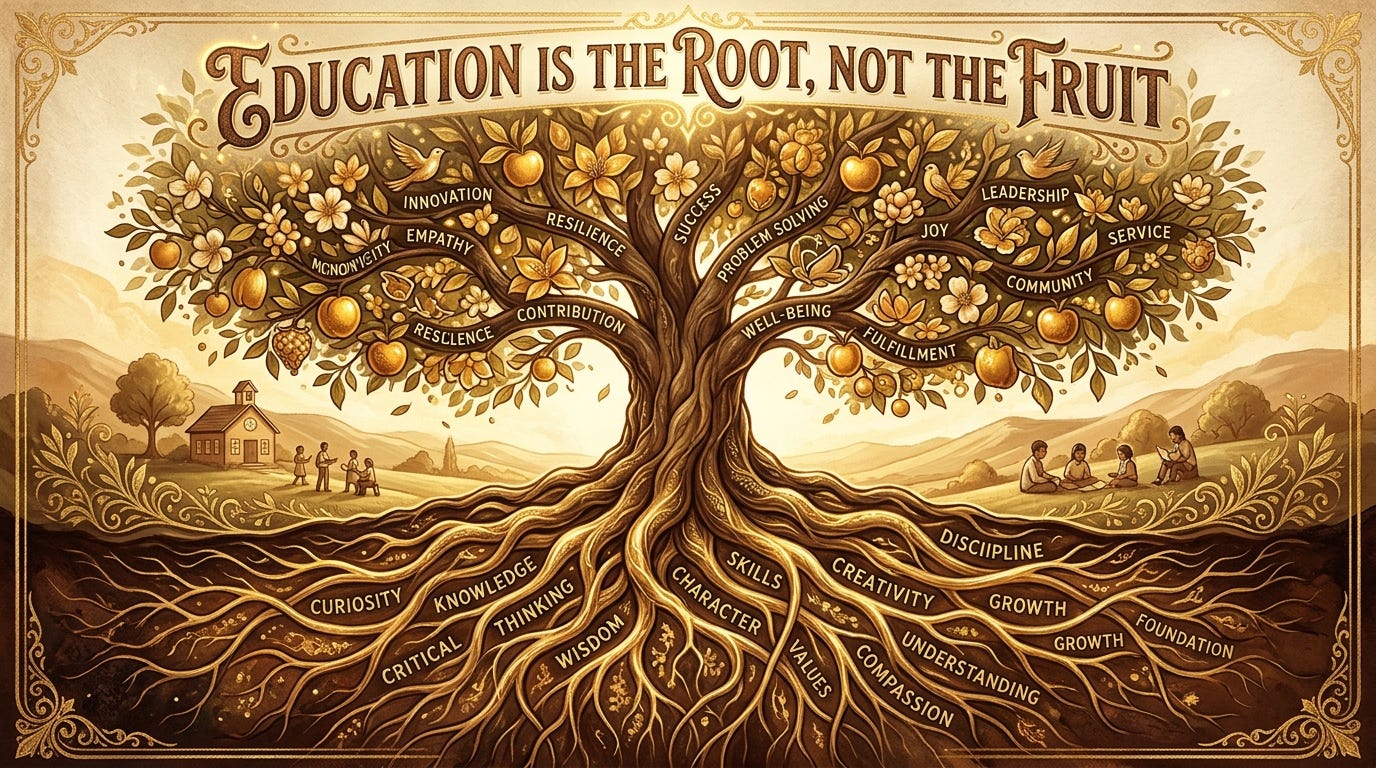
If we trace the causal chain backward, the metacrisis isn’t the root. It’s the fruit. It’s what grows, further down the line, from a seed planted much earlier, in the classroom, in the lecture hall, in the entire architecture of how we teach young people to think about themselves and their place in the world. The metacrisis is downstream. Education is upstream. Calling education itself the metacrisis collapses that distance, and I think something important is lost when we do that, namely the clarity of knowing exactly where intervention needs to happen, and how far its effects still have to travel before we see them play out in the world.
The Quiet Theory Running Underneath Everything
To understand why education produces this outcome, it helps to look at the theoretical scaffolding holding up most of contemporary schooling, something called human capital theory. It’s rarely spoken aloud, and most people who pass through the system never encounter the term directly, but it shapes nearly every incentive inside modern universities.
Human capital theory treats education primarily as an economic mechanism: a way of training tomorrow’s workforce, with employability as the implicit, and often explicit, end goal. Under this framework, a human being isn’t approached primarily as a full person with inner life, moral agency, or spiritual depth. They’re approached as a productive asset. A unit of potential output. A peg, shaped and sanded down until it fits neatly into the machinery of the economy.
This isn’t a conspiracy theory or an exaggeration. It’s simply the operating logic beneath curriculum design, funding priorities, and institutional messaging at most universities today. Employability metrics. Graduate salary rankings. Corporate recruitment pipelines built directly into business schools. The entire architecture is optimized for one thing: producing workers who can be usefully slotted into existing economic structures, with minimal friction and maximum output.
What’s largely absent from this picture is any serious institutional interest in what philosophers have long called the alethic values: truth, beauty, and goodness. These aren’t decorative, old-fashioned ideals with no practical use. They are the actual compass points by which a person might learn to evaluate whether the systems they’re building, the companies they’re running, or the policies they’re writing are actually good, not just profitable, not just efficient, but good, in the deep and difficult sense of the word.
What we need, I’d argue, is nothing short of a radical reimagining of education’s purpose, a full reprogramming of what the system is for. Not the optimization of market output, but the cultivation of human beings capable of pursuing truth, recognizing beauty, and acting from goodness, even, especially, when doing so runs counter to economic incentive.
My Own Education, In Hindsight
I didn’t arrive at this critique from the outside. I lived inside the very system I’m describing.
I completed both my bachelor’s and master’s degrees in Business Administration in London, two entire cycles of formal education, at what are considered some of the more prestigious institutions for that field. And in all that time, I was never once prompted to reflect on social or cultural evolution. Never once asked to think seriously about the polycrisis, or the deeper trajectory of the civilization I was being trained to serve. Not once did a professor ask me to consider whether the skills I was acquiring were oriented toward truth, beauty, or goodness, only ever toward competence, competitiveness, and employability.
And it worked exactly as designed. My education primed me, quite effectively, to walk directly into a high-paying consultancy position in one of the world’s major financial hubs. That is precisely what I did. At the time, it felt like success: the system had done its job, and I had done mine.
Looking back now, though, it’s strikingly clear how thoroughly that entire educational experience was calibrated to serve the human-resource needs of large corporations, not to cultivate wisdom, not to develop discernment, not to help me or my classmates grapple with the deeper questions our historical moment actually demands of us. We were being manufactured, gently and invisibly, into a very specific kind of usefulness.
Where This Leaves Us
If Stein is right that something at the root of our civilizational crisis runs through education, then the work ahead isn’t just reforming curricula or adding a few “ethics” electives to business school requirements. It’s something closer to a wholesale reorientation of what we believe education is for, away from producing employable units, and toward cultivating whole human beings capable of discernment, wisdom, and care for the world they’re about to inherit responsibility for.
That reorientation won’t come from the top down. It has to start with those of us willing to notice, honestly, how thoroughly we ourselves were shaped by the very system we’re now trying to see clearly.